Thursday, January 19, 2017

Side-Street Bikeways Are Great- If You Have Protected Bike Lanes Too

Can we, as a planet, please retire the idea that cities face a choice between putting all-ages bikeways on low-traffic side streets and putting all-ages bikeways on busy arterials?
The data show exactly the opposite — and also suggest that putting bikeways only on side streets might actually be the worst course of action.
On Monday, Canada's national Globe and Mail newspaper offered the latest installment of this understandable but misguided narrative. It's part of a series about projects "that aren’t often talked about because they actually work."
The idea is that the bike boulevards of Vancouver are uncontroversial, and therefore good:
[Protected bike lanes'] most ardent critic, CKNW radio shock jock Bruce Allen, has spent numerous segments railing against the “big ugly cement barriers that turned our streets into eyesores.”
And yet, he is a fan of the more understated network of traffic-calmed residential streets that allow cyclists to traverse the city in relative safety and peace. ...
Urban-planning and transportation experts have long feted Vancouver’s extensive system of bike-friendly side streets as a cheap and uncontroversial way for bike-resistant North American cities to create the infrastructure that gets people out of their cars and onto two wheels.
It's true that Vancouver's bike boulevards are relatively cheap and uncontroversial. It's also true that they're good.
Read the rest of the story here.

Wednesday, January 18, 2017

Tapping The Power Of Place To Keep Us All Healthy

One number stands above all others as the best indicator of good health. It’s not your blood pressure, cholesterol level, average daily calories or even the age at which your grandparents die. It’s your zip code.

This fact has sent shock waves across the county. The chief aspiration of American democracy is that everyone deserves an equal opportunity for life, liberty and the pursuit of happiness. Yet medical evidence shows that people living in disadvantaged neighborhoods face greater health and mortality risks.

“That should not be…. All communities should have a right to a safe, sustainable, healthy, just, walkable community,” says Robert Bullard, the father of the environmental justice movement and a professor of Urban Planning and Environmental Policy at Texas Southern University.

“Health disparities don’t just happen by accident,” he declared at the 2nd National Walking Summit, accentuating his point with a series of maps showing that high levels of diabetes, hypertension, heart disease and obesity correlate strongly with low-income neighborhoods and those with a history of racial segregation.

Read the rest of the story here.

Tuesday, January 17, 2017

Vehicular Cycling Is Dead, Just Don’t Bury The Body Yet

The biggest argument in urban cycling of the last 20 years is pretty much settled. So why are we still arguing about it?
After last week’s post about the ways Montreal managed to become one of the continent’s most bike-friendly cities, that old saw fired up again. Much of the commentary focused on the perceived shortfalls and benefits of vehicular cycling, which is a a philosophical and practical guide to getting around a city on a bike, described by its chief proponent John Forester like this: “Cyclists fare best,” he wrote in his 1976 book Effective Cycling, “when they act and are treated as drivers of vehicles.”
Untitled
For a long time, this was a dominant idea among North American bike advocates, but over the last 20 years, a counter theory grew that was, in some ways, the polar opposite. Rather than accepting bicycles as vehicles on a road, the new idea has cyclists being accommodated with dedicated infrastructure that keeps them segregated from cars.
Cue the bicycle culture wars, with factions on each side battling it out like Buckley versus Vidal (or, perhaps more accurately, Hitchens versus Hitchens) to the bafflement of outsiders who could never seem to understand why people who all loved bikes hated each other so much.
Read the rest of the story here.

Friday, January 6, 2017

The Real Problem With Higher Parking Meter Rates: They’re Not High Enough

Wouldn’t it be wacky if the cost of driving went down and up when market conditions change? Oh, wait, it already does: New vehicles get more expensive as automakers lure buyers with new features. After plunging for years, amid a global oil glut, the cost of gasoline is rising again.

 People take that in stride. But for some reason, we view free or low-cost parking as a human right, and we’re all shocked when the City of Boston asks drivers to pay extra for curbside spaces in jam-packed areas. Recently, Mayor Martin Walsh announced plans to hike parking meter rates from $1.25 an hour to $3.75 in the congested Back Bay and impose varying rates of up to $4 an hour in the Seaport District. The move provoked some drama, as a Globe story showed: “Nickel-and-diming commuters,” City Councilor Michael Flaherty called it. Vicki Smith, the chairwoman of the Neighborhood Association of the Back Bay, said her group was “blindsided” by the move. “I think I need to move to a different state,” a motorist on Newbury Street told a reporter.

 Relax. Moving lots of people and stuff in and out of congested spaces is a fundamental challenge in cities. Parking meters allow motorists to take turns using scarce curbside spaces, and should cost enough that there are vacancies on every block.

 If there’s a problem with Walsh’s experiment with higher rates, it’s that he didn’t jack them up enough.

Read the rest of the story here.

Thursday, January 5, 2017

The Unlikely Success Of Calgary’s bike-Lane Network Has These Lessons For Other Cities

Monday was a big day for Calgary. After an 18-month pilot project testing out a downtown network of separated bike lanes, city council voted to make the project permanent. It was a squeaker of a majority vote that approved the pilot project in the first place, so its permanence was never assured.
In the end, more city councillors voted in favour of keeping the network than approved the pilot project in the first place, which means several changed their votes in favour after seeing the bike lanes in action. “I was a person that didn’t support this in the beginning. I thought this was madness,” Coun. Diane  Colley-Urquhart told reporters after the vote. “But, to see how it’s evolved, and how it’s working and to see how people are starting to get the fact that this is shared public space.”
I argued in favour cycle tracks in places like this, this and this, so I’m certainly pleased with the result in my home town. The process also taught us much that may be applied to other cities.
Read the rest of the story here. 

Wednesday, January 4, 2017

A Bike Network With Just Trails Is like A Car Network With Just Freeways

If you've got a long way to go, or nowhere to go in particular, nothing beats an off-street path.
The Danes, masters of urban bike infrastructure, have a name for the nicest of their off-street paths: "cycle superhighways." It's apt. For better and for worse, a great bike path is a sort of tiny freeway. (Though it tends to smell much nicer.)
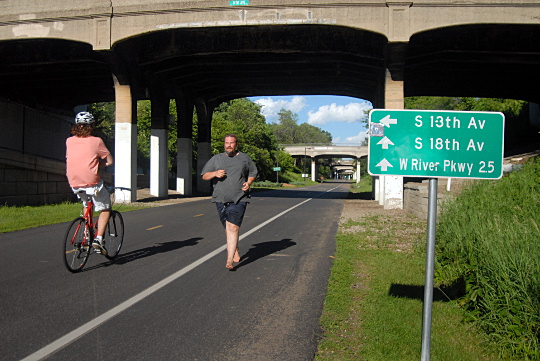
Maybe this helps explain why the United States, though it's lagged in building all-ages bike lanes, is so good at building nice bike paths. Minneapolis's Midtown Greenway, for example, is one of the wonders of the biking world:
Read the rest of the story here.

Tuesday, January 3, 2017

The U.S. Now Has 12 Protected Intersections, Up From 4 In 2015 And 0 In 2014

The country's newest major bike-lane innovation is very young. But so far, it's spreading faster than the protected bike lane did.
Protected intersections — a clever way to rearrange traffic so that people on bikes and cars no longer have to look over their shoulders for each other — have existed for decades in other countries. But after they were visualized for the U.S. context in 2011 by the Dutch blogger Mark Wagenbuur and given a name in 2014 by the U.S. planner Nick Falbo, the design burst into the spotlight. Last year, four opened to regular traffic: two in Austin, one in Salt Lake City and one in Davis, California.
This year, the country added eight more. They arrived in Atlanta, Ga.; Berkeley, Calif.; Chicago, Ill.; College Station, Tex.; and San Francisco, Calif.
Read the rest of the story here.