Thursday, July 16, 2015

District Government Gives Green Light To Parks In Parking Spaces

In the past week, carpenters screwed 10 banana-and-mustard-colored triangular planters, a bench and a table to a plywood platform taking up two parking spaces on K Street NW. Then they came back and touched up the paint and put up reflective safety posts. On Sunday, ferns and lavender are set to go in.
And on Tuesday, Washington’s newest park is to open to the public.
“I told my sister, ‘Hashtag: It-just-popped-up!’ ” said Randy Parz, one of the builders.
The District has started allowing people to take over parking spaces and turn them into year-round mini-parks. San Francisco helped spawn such spaces, dubbed “parklets.”
Read the rest of the story at the Washington Post.

Wednesday, July 15, 2015

Streets and Sidewalks Should Be Used to Improve Our Health

Streets and sidewalks take up 25 to 50 percent of a typical U.S. city’s land. New York City, for example, is on the lower end of that scale at 28 percent and Chicago (42 percent), Washington D.C. (43) and Portland, Oregon (47) are at the higher end.

This, believe it or not, presents a huge opportunity for us to address mental health through urban design. Problem is, streets and sidewalks represent space that’s largely under control of our city governments. In most cases our local departments of transportation.

Read the rest of the story at Mobility Lab.

Tuesday, July 14, 2015

What does "Smart Growth 2.0" mean for Arlington?

In discussing the state of the county, Arlington County Board chair Mary Hynes recently called on residents to help "chart a new course" to plan for the future. Hynes says we need a "2nd generation of Smart Growth," and ArlNow called Hynes' vision Smart Growth 2.0. What do you think Arlington's priorities should be?

Photo by Cliff on Flickr.
Arlington officials will soon unveil a new county transportation plan, prioritizing transit improvements between Crystal City, Columbia Pike and Rosslyn. What, exactly, will be in that plan is still unclear.
In her State of the County address last Friday, Hynes said increased competition, strained resources and little remaining developable space demand that we update how we approach transportation and development.
"Those incredible ups that we had are not going to come Arlington's way again," Hynes said. "I challenge each of you to be part of the solution."
Read the rest of the story here.

Monday, July 13, 2015

Gov. McAuliffe Announces Deal Ensuring No Tolls on the MLK Freeway Extension in Portsmouth

PORTSMOUTH – Gov. Terry McAuliffe today announced an agreement that ensures no tolls will be collected on the Martin Luther King (MLK) Freeway extension project, a key achievement in his work to reduce the financial impact of major construction improvements on motorists in Hampton Roads. 
The agreement also includes provisions to ease the tolling burden related to projects on the Midtown and Downtown tunnels for residents who are most severely impacted due to financial, medical or other circumstances. The MLK extension, the new Midtown Tunnel under construction, and the rehabilitation of the Midtown and Downtown tunnels are collectively known as the Elizabeth River Tunnels project.
“After a great deal of work, we now have a plan in place to ease the financial pressure of tolling, particularly for Portsmouth residents,” said Gov. McAuliffe. “The Elizabeth River Tunnels project must be built to reduce congestion, increase safety and improve the economy. This is the right project, but a bad deal reached under the prior administration. Since I took office, toll rates on the tunnels have been lowered during construction. We have worked with our private sector partner to ensure there will be no tolls on the MLK extension.  Imposing a toll to finance the improvements would have placed an unfair burden on the citizens of Portsmouth. It is not good policy for Portsmouth to bear the cost of this project when it is also sharing the tolling burden with other motorists in the region who travel the Midtown and Downtown tunnels.”
The state will transfer $78 million that was set aside for Route 460 improvements in southeast Virginia to buy out the tolls on the MLK extension project.
“Regarding the Midtown and Downtown tunnels, there will be some relief to ease the tolling burden on those residents who are the most financially impacted,” added Transportation Secretary Aubrey Layne.  “Our contractor, Elizabeth River Crossings (ERC), has agreed to pay $500,000 a year for 10 years to help offset the cost of tolls to those toll users who are the most financially stressed. I have directed Deputy Secretary of Transportation Grindly Johnson to lead this effort and work with the local community to ensure these monies are invested in the most beneficial way to ease the financial burden of tolls on those residents who need the help the most.”
The cost for toll violations will be capped. The highest amount that ERC can charge for violations regarding unpaid tolls, fees and court courts cannot exceed $2,200.  VDOT will be working in collaboration with ERC and the community to better inform and educate the region about the EZPass program, making tolling as easy and convenient as possible for motorists. 
The Department of Rail and Public Transportation will work with Hampton Roads Transit to make certain the state’s subsidy of $2 million will be used specifically to move more people with fewer cars through the tunnels. 
For more information on the project, go to www.driveert.com.

Tuesday, July 7, 2015

How to Make Smart Growth More Lovable and Sustainable

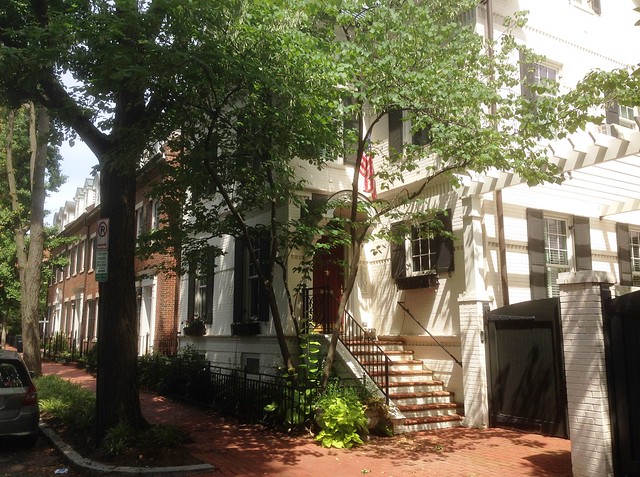
While on my way to a dental appointment last week -- not my favorite activity, truth be told -- I had the distinct pleasure of walking through Georgetown, Washington's oldest neighborhood and one of its most lovely. As I ambled through the historic, tree-lined streets, I was reminded of how our older neighborhoods so often embody the characteristics that we now ascribe to "smart growth."
In particular, Georgetown has a walkable urban density; well-connected streets and sidewalks that make it notably pedestrian-friendly; a central, convenient location just a mile or so from the heart of downtown; good transit service; many shops, restaurants and civic amenities mixed in with, or a ridiculously easy walk from, the neighborhood's homes. These attributes are the essence of what those of us who advocate smart growth advocate for. And, while Georgetown's historic district is the one closest to my home, DC certainly has other lovely old neighborhoods with similar features, and so, actually, do most cities in America. Perhaps you have your own favorite.
Read the rest of the story at Huffington Post.

Monday, July 6, 2015

Gov. McAuliffe Announces Settlement to Recover Taxpayer Dollars From Route 460 Contract

CHESAPEAKE – Gov. Terry McAuliffe today announced that his administration has reached an agreement with U.S. 460 Mobility Partners, the company that was contracted to execute the now-cancelled US Route 460 public-private partnership, which will return $46 million in already-spent funds back to taxpayers and cancel an additional $103 million claim the company had filed under the contract. The total $149 million swing is the result of months of negotiations between the McAuliffe administration and the company.  
“This settlement will bring millions in taxpayer dollars that were wasted on the U.S. Route 460 project back to taxpayers and prevent the Commonwealth from having to pay millions more,” said Gov. McAuliffe. “While this is a positive development, the fact remains that Virginians have already spent hundreds of millions of dollars on a project that will never be built because state officials negotiated a contract that left the Commonwealth holding the bag when the environmental risks were too great to move forward. I regret that that contract did not allow for greater steps to mitigate the impact of this failed project, but I am proud of the bipartisan reforms we worked with leaders like Delegate Chris Jones to make to prevent disasters like this from occurring in the future.”
Gov. McAuliffe announced the settlement at a ceremonial bill signing for new bipartisan legislation that reforms Virginia’s approach to public-private transportation projects in the wake of the failed U.S. Route 460 project. House Bill 1886 reforms how Virginia finances transportation projects under the Public-Private Transportation Act, or P3 program. The new law will prevent bad P3 deals and identify beneficial opportunities to protect the public’s best interests.
House Bill 1886 requires three key factors:
  • An independent screening committee, with representation from the General Assembly, will decide if a transportation improvement should be financed as a P3 project. These meetings will be open to the public.  For the first time, the General Assembly will be involved and engaged from the beginning. 
  • Critical to the decision making is the level of risk involved. The risk must be transferred from the taxpayers to the private sector. Decision makers will have access to all the risks involved in a potential P3 deal so they can make the right decision. The law puts in place new procedures for high-risk projects that will shield the public from unexpected liabilities.     
  • The legislation will draw clear lines of accountability. The secretary of transportation will be required to sign a document attesting that the project qualifies as a P3 project, meaning risk has been transferred to the private sector and that the original purpose of the procurement has not changed. 
“There will be no way to duck responsibility for transportation decisions,” said Transportation Secretary Aubrey Layne.  “It will protect taxpayers from undue risk, while using the P3 process in the intended way to deliver projects that move Virginia’s economy.”

Wednesday, July 1, 2015

Businesses Moving to Where the Public Transportation Is – Downtown

The deciding factor in Panasonic’s move of its North American headquarters from Secaucus, New Jersey to Newark was public transportation, according to Jim Reilly, vice president of corporate communications.

The company relocated from a large corporate campus with lots of green space to an amenity-rich downtown location. Reilly said his company’s relocation has been “transformative” and has created a more collaborative company culture.

After years of locating in car-dependent, suburban office parks, large numbers of companies are now moving back downtown.

Read the rest of the story here.